Solunar shows the sun and moon for any place: when they rise and set, how long the light lasts, and the moon’s phase. Everything is calculated offline.
Open Solunar#
In the sidebar, under Forecast, tap Solunar. On Home, the Sun and Moon tiles in the Weather section open Solunar for where you are.
Your places#
Solunar shares its list of places with Daily Summary and Tables & Graphs, and the place you pick in one is picked in all three. Here each row shows the moon, today’s sunrise and sunset, and the moon’s phase, like Waxing Gibbous · 73%.
To add, remove, or reorder places, see Your places in the Daily Summary guide.
Pick a day#
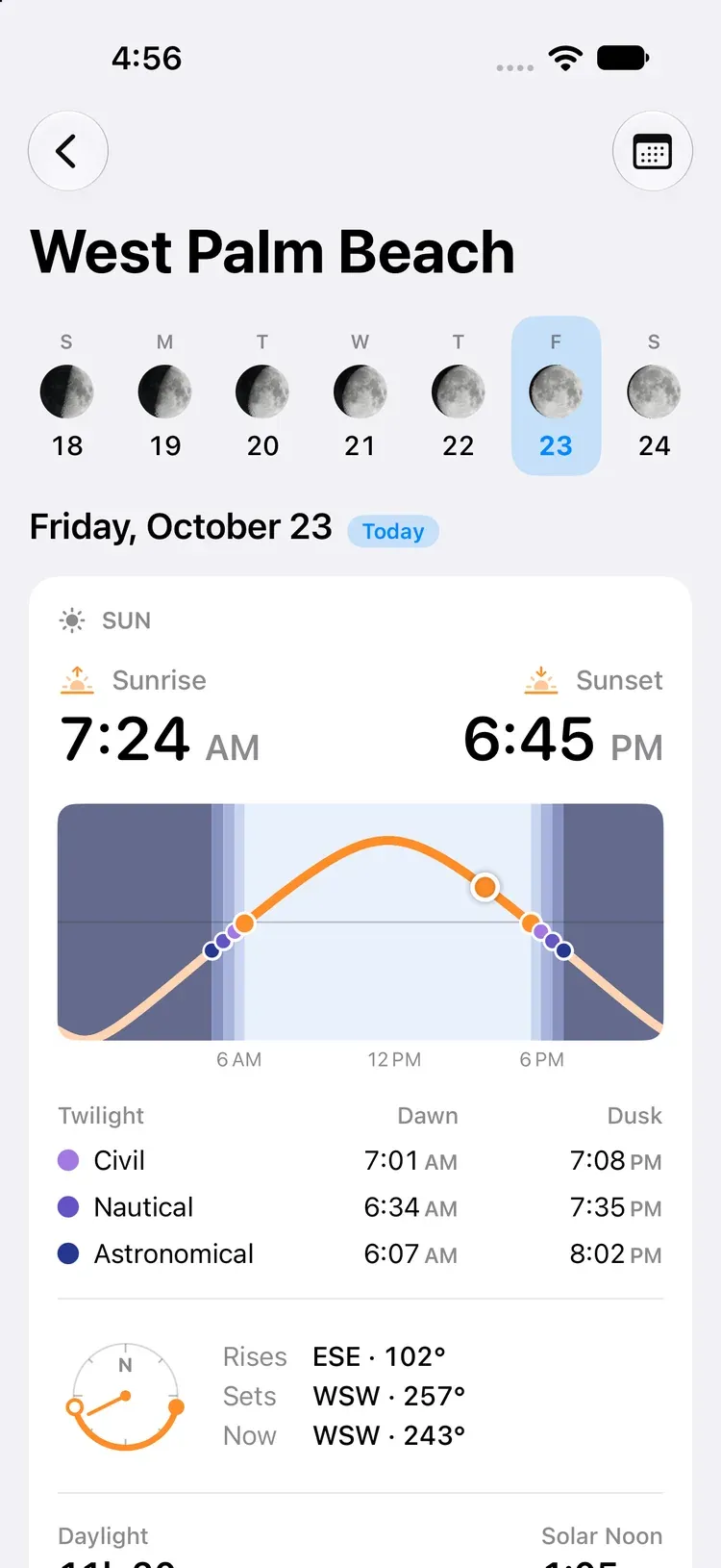
- The week strip at the top shows each day’s moon. Swipe it a week at a time, from a year back to two years ahead.
- Today brings you back to today.
- Moon Phases opens a calendar of the moon, a month at a time, with the exact time of each new moon, first quarter, full moon, and last quarter. Tap a day to jump to it.
On Android: Moon Phases opens full screen; press Back to return.
The sun#
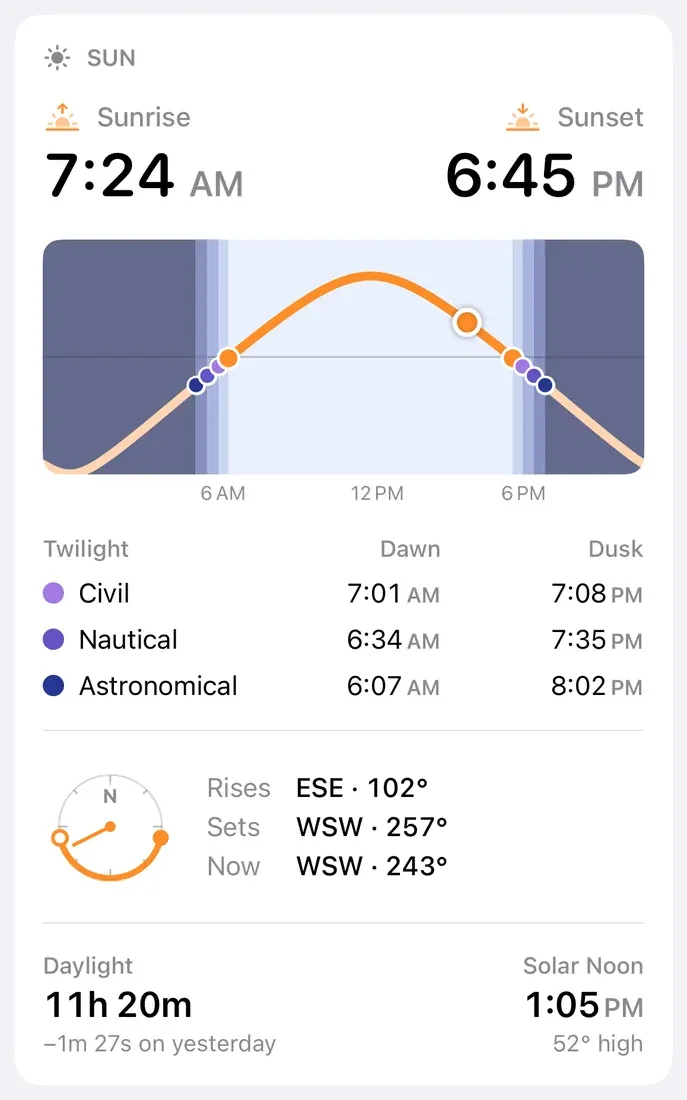
- Sunrise and Sunset.
- A chart of the day from midnight to midnight, with night and each stage of twilight shaded, and a dot at now.
- Twilight: dawn and dusk for each stage. Civil twilight is light enough to work on deck without lights. At the end of nautical twilight the horizon fades. Astronomical twilight ends when the sky is fully dark.
- Bearings: where the sun rises and sets, and where it is now, on a compass dial, like Rises ENE · 68°. These are true bearings.
- Daylight: how long the sun is up, and how that compares with yesterday.
- Solar Noon: when the sun is highest, and how high it gets.
Near the poles, Solunar tells you when the sun stays up all day or doesn’t rise at all.
The moon#
- The moon itself, drawn from NASA’s maps of the lunar surface and lit and tilted the way it looks from that place.
- The phase, how much of it is lit, and how many days old it is. A Supermoon badge marks a full moon that’s closer than usual.
- Moonrise and Moonset, with a chart and bearings like the sun’s.
- Transit: when the moon is highest, and how high.
- Next Full Moon, Next New Moon, and how far away the moon is.
Times are in the place’s own local time. My Location uses your device’s time zone. Rise and set times are for sea level.
Offline#
Solunar needs no connection. Every time is calculated on your device, and checked against the US Naval Observatory’s figures. Adding a new place by search or on the map does need a connection.
Solunar is free.