Myth: the compass is a backup. The chartplotter is accurate, so the compass just sits there in case the electronics die, and you never touch it otherwise.
Correction: the compass is the thing you reach for when the electronics do die, and if you have never swung it, you do not actually know what it reads. Deviation — the error caused by your own boat’s iron, wiring, engine, and electronics — is not one number. It changes with heading, because the metal around the compass changes position relative to magnetic north every time you turn. A compass can be dead accurate on one heading and ten degrees off forty-five degrees later. Variation, the difference between true and magnetic north, is printed on the chart and is the same everywhere nearby. Deviation is yours alone, and only swinging the compass tells you what it is.
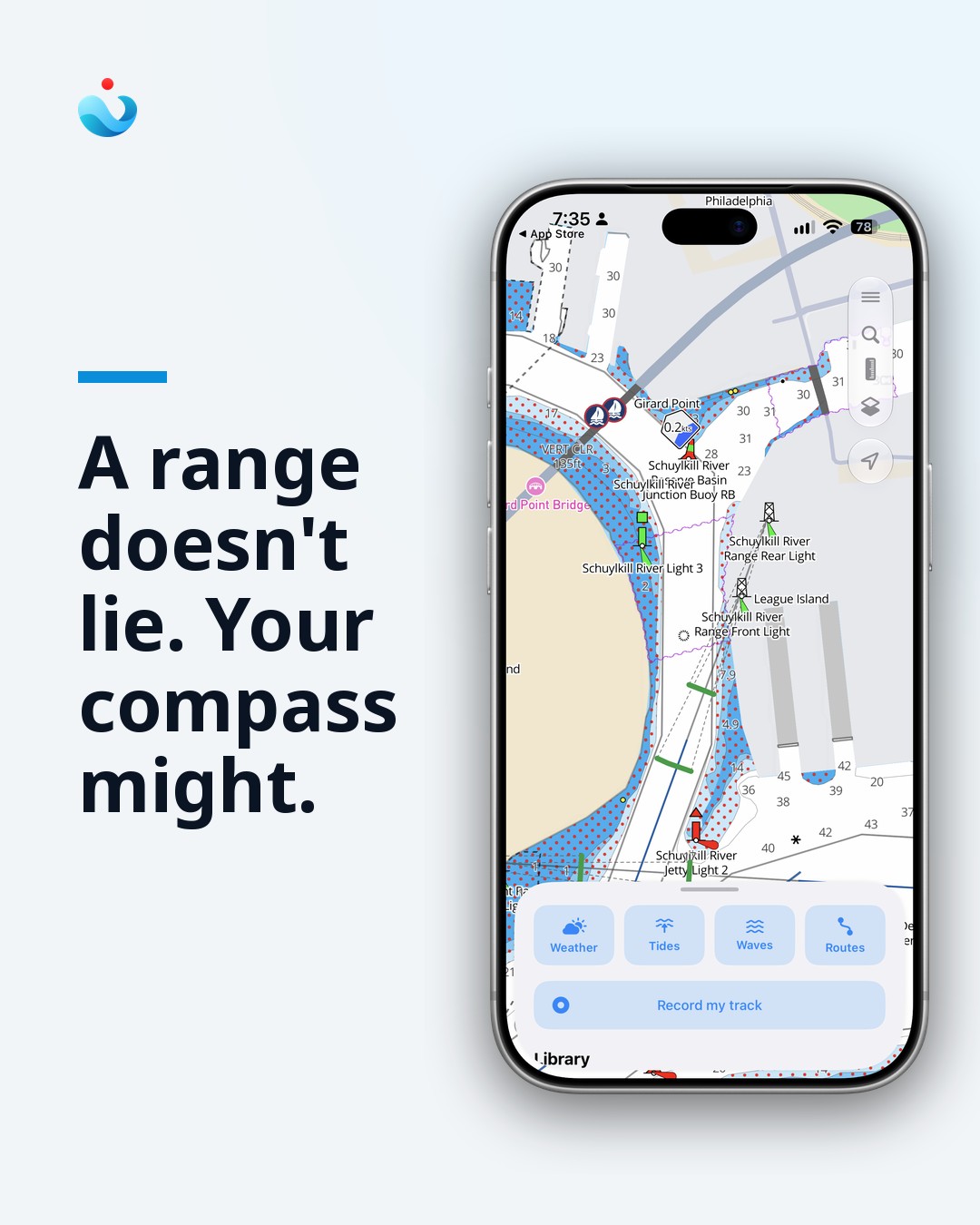
A range gives you the one thing you need to do that: a precisely known true bearing, for free, already on the chart. Two charted objects — a pair of daybeacons, a tower and a stack, a church spire behind a monument — in line define a bearing you do not have to estimate. When you are on that line, you know exactly what the true course is. Compare that to what your compass reads at that moment, on that heading, and you have one point of deviation.
The practical rule: find a charted range near your home port, run it on a calm afternoon, slow and steady, and record the compass reading every time you cross the line on a new heading. Eight headings, roughly forty-five degrees apart, is enough to build a usable table — you do not need every heading, just enough points to see the pattern and interpolate between them. Each pass: line up the range, note the compass heading at that instant, note the known true bearing from the chart, and write down the difference. That difference is your deviation on that heading.
A few things make the afternoon go cleanly. Check the range’s charted bearing on the chart before you leave the dock so you are not hunting for it mid-run — OceanPulse’s NOAA charts show the range objects and their positions, and press-and-hold on either one gives you its details on the spot, so you are not flipping between a paper chart and a pair of binoculars. Drop a marker at the point where the range lines up on each heading, so you have a record of exactly where each reading was taken. Log the whole swing as a track — it is a useful record to have the next time you do this, and a sanity check if a reading looks off and you want to rerun it.
Once you have your eight points, write the table and keep it where you can see it at the helm — taped to the binnacle, not buried in a drawer. Redo the swing after any engine work, after adding electronics near the compass, after a refit, or every few years regardless. A compass does not drift on its own, but your boat changes, and the compass only knows what is around it right now.
None of this needs instruments you do not have. It needs a charted range, a calm afternoon, and the discipline to write down eight numbers instead of trusting that the needle has always been fine.